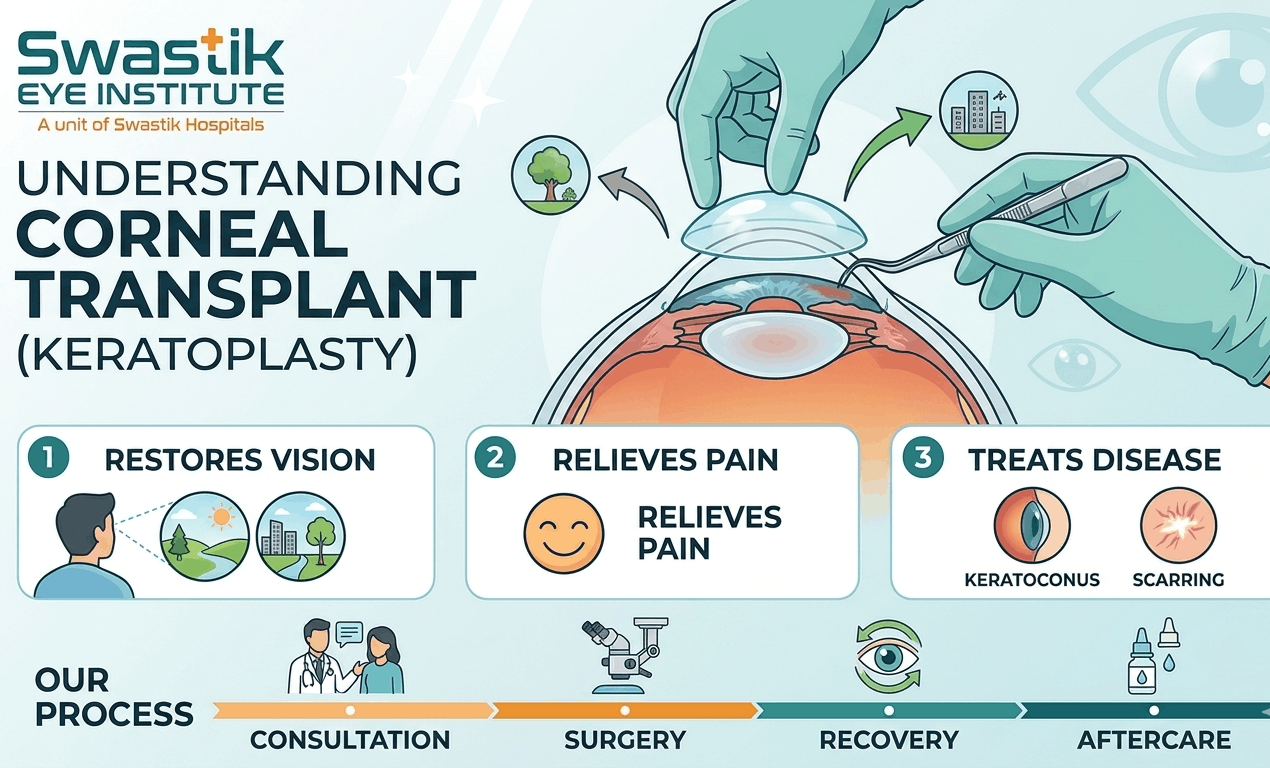
The cornea is the clear, dome-shaped outer window positioned at the very front of your eye. It plays a critical role in focusing light so you can see sharply. If this window becomes scarred, swollen, thinned out, or structurally distorted due to disease or injury, light cannot enter the eye correctly, causing severe vision loss or blindness.
A corneal transplant, clinically known as keratoplasty, is a highly specialized surgical procedure where damaged or diseased corneal tissue is intricately removed and replaced with healthy, clear donor corneal tissue.
At Swastik Eye Institute, we utilize advanced microsurgical techniques. Instead of always replacing the entire cornea, our specialists frequently perform selective component transplants (lamellar keratoplasty), replacing only the specific microscopic layers that are diseased to ensure much faster healing and significantly lower rejection rates.
Risk Factors
Causes & Risk Factors
A cornea can lose its structural integrity or transparency due to a variety of genetic conditions, progressive thinning disorders, or external physical traumas.
Advanced Keratoconus:A progressive condition where the cornea thins out and bulges outward into an irregular cone shape.
Surgical Complications: Occasional corneal edema or bullous keratopathy arising after complex structural intraocular surgeries.
Fuchs' Endothelial Dystrophy: A hereditary condition causing gradual failure of the innermost corneal layer, leading to fluid buildup and severe swelling.
Corneal Scarring & Ulcers: Permanent scarring left behind by severe bacterial, viral (such as Herpes), or fungal eye infections.
Ocular Trauma:Chemical burns, physical punctures, or severe lacerations directly damaging the corneal surface.
Signs to Watch
Symptoms Indicating Corneal Damage
When your cornea is compromised, everyday tasks become increasingly difficult. If you experience these progressive symptoms, an evaluation by a corneal specialist is crucial.
Severe Visual Distortion
Chronic Pain or Grittiness
Extreme Light Sensitivity
Cloudiness or Hazy Vision
How We Help
Tailored Corneal Transplant Procedures
Modern ophthalmology allows us to target specific layers of the cornea. We offer tailored transplant options depending entirely on which portion of your cornea needs replacement.
Penetrating Keratoplasty (PKP) - Full Thickness
A traditional full-thickness transplant procedure used when all layers of your cornea are severely damaged or scarred. The surgeon removes the entire central portion of the host cornea and replaces it with a full donor graft, carefully anchoring it into place using ultra-fine micro-sutures.
45 to 60 Minutes 6 to 12 Months 85% success
Deep Anterior Lamellar Keratoplasty (DALK)
An advanced partial-thickness transplant where the outer and middle layers of the cornea are replaced, preserving the patient's own healthy inner endothelial layer. This is highly effective for advanced Keratoconus and dramatically minimizes the long-term risk of graft rejection.
Description: A revolutionary, micro-incision, layer-specific surgery designed for conditions like Fuchs' Dystrophy. Only the damaged, ultra-thin innermost cell layer is removed. The healthy donor layer is inserted through a tiny incision and held perfectly in place using a temporary internal air/gas bubble—requiring minimal to no sutures.
The eye will be patched initially. Expect some mild discomfort, wateriness, and light sensitivity. Intensive corticosteroid and antibiotic eye drops must be strictly administered as prescribed. For layered procedures like DSEK, specific head positioning may be required for a few days to secure the graft bubble.
Months 1 - 3: Structural Stabilization
Vision begins to clear gradually but will fluctuate. Frequent follow-up appointments at Swastik Eye Institute are vital to monitor graft acceptance. Protective eyewear should be worn consistently, and all strenuous activities, swimming, or heavy lifting must be strictly avoided.
Months 6 - 12+: Selective Suture Removal & Final Vision
For full-thickness transplants (PKP), tiny micro-sutures remain in place for several months to ensure perfect bonding. The corneal specialist will systematically remove individual sutures over time to mold the corneal shape and reduce astigmatism. Final corrective glasses or specialized scleral contact lenses are then prescribed for definitive clear vision.
Common Questions
Frequently Asked Questions
Because the cornea is naturally avascular (does not contain blood vessels), it has one of the lowest rejection rates of any transplanted organ. Rejection risks are significantly lower in layered procedures (DALK/DSEK) compared to full-thickness surgeries. Most rejection episodes can be completely reversed with localized steroid eye drops if detected early during your routine checkups.
At Swastik Eye Institute, we coordinate directly with certified, accredited national eye banks. The waiting period depends heavily on tissue availability and scheduling, but elective cases are usually scheduled systematically within a reasonable timeframe once structurally viable donor tissue is secured and thoroughly tested.
This depends on the specific surgical technique used. DSEK/DMEK patients often return to desk jobs within 2 to 3 weeks. Full-thickness PKP patients may need 4 to 6 weeks off before resuming regular work, and up to a year before engaging in contact sports or vigorous physical activities. Protective eyewear is highly recommended permanently for outdoor activities post-surgery.